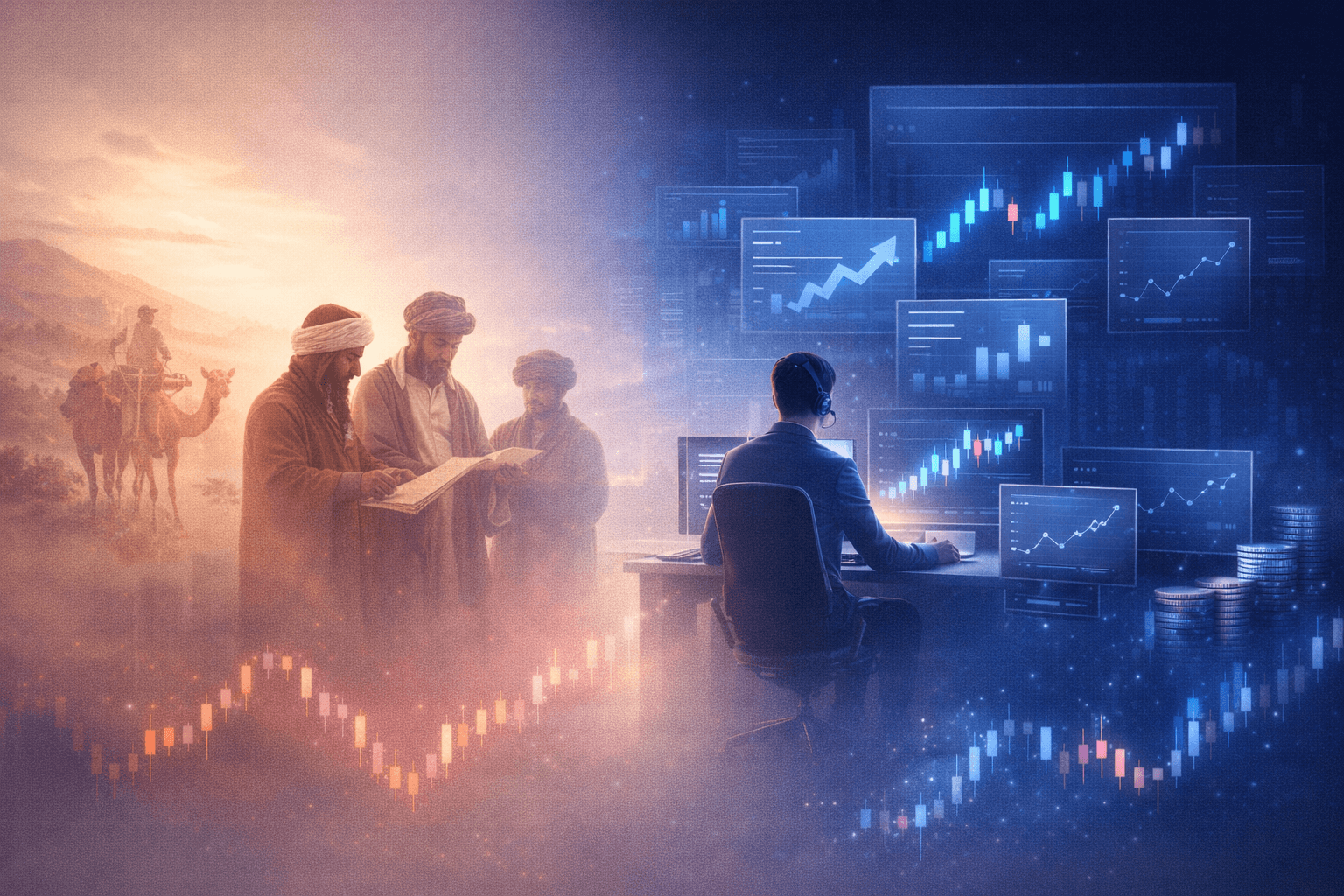

History is not just a record of events—it is a record of decisions. From ancient merchants navigating uncertain trade routes to modern traders executing orders in milliseconds, one principle has remained unchanged: success depends on making the right choices under uncertainty.
Thousands of years ago, traders had to decide which routes to take, which goods to carry, and whom to trust. Today, those decisions have evolved into selecting assets, strategies, and even the infrastructure itself—such as how to choose a trading platform that ensures reliability, speed, and efficiency in financial markets.
In this article, we will explore the evolution of trade across history and uncover how the same principles that guided ancient merchants still shape modern trading decisions.
Ancient Trade: The Foundations of Economic Thinking
Trade began long before formal markets existed. Early civilizations exchanged goods based on necessity, but over time, trade evolved into a structured system.
Key Civilizations and Their Contributions
- Mesopotamia — introduced early accounting systems
- Ancient Egypt — developed trade routes along the Nile
- Greece — expanded maritime trade networks
- Rome — standardized currency and contracts
These civilizations laid the groundwork for economic systems by introducing concepts like value, exchange, and trust.
| Aspect | Ancient Trade | Modern Equivalent |
|---|---|---|
| Goods | Grain, metals, spices | Stocks, currencies, crypto |
| Medium | Barter, coins | Digital assets |
| Trust | Personal reputation | Platforms and regulation |
| Execution | Manual exchange | Automated trading |
While the tools have changed, the underlying logic remains strikingly similar.
The Rise of Trade Routes and Risk Management
One of the most important developments in history was the creation of long-distance trade routes, such as the Silk Road.
These routes introduced a new challenge: uncertainty.
Risks Faced by Ancient Traders
- Bandit attacks
- Weather conditions
- Political instability
- Unpredictable demand
To survive, traders had to develop early forms of risk management:
- Diversifying goods
- Forming partnerships
- Choosing safer routes
This mirrors modern trading strategies, where diversification and risk control are essential for long-term success.
Medieval Markets: The Birth of Financial Systems
During the Middle Ages, trade became more organized, leading to the emergence of financial institutions.
Key Innovations
- Bills of exchange — early form of credit
- Banking systems — introduced by Italian merchants
- Trade fairs — centralized marketplaces
These innovations reduced the need to carry physical wealth and made trade more efficient.
In many ways, this was the first step toward modern financial markets.
The Age of Exploration: Expansion and Globalization
The 15th and 16th centuries marked a turning point in trade history.
European explorers opened new trade routes, connecting continents and expanding markets.
Impact on Trade
- Increased volume of goods
- Introduction of new commodities
- Greater competition
With expansion came complexity—and the need for better decision-making.
Traders now had to analyze multiple variables, much like modern traders evaluating global markets.
The Birth of Stock Exchanges
The next major milestone was the creation of stock exchanges.
The Amsterdam Stock Exchange, established in the 17th century, is often considered the first modern exchange.
Why It Was Revolutionary
- Allowed investors to buy shares
- Enabled capital raising for large ventures
- Introduced liquidity
This marked the beginning of organized financial markets.
| Feature | Early Exchanges | Modern Platforms |
|---|---|---|
| Access | Limited to elites | Global access |
| Speed | Slow, manual | Instant execution |
| Transparency | Low | High (regulated markets) |
The evolution from physical exchanges to digital platforms has dramatically changed accessibility—but not the core principles.
Industrial Era: Acceleration of Markets
The Industrial Revolution brought technological advancements that transformed trade.
- Railways improved logistics
- Telegraphs enabled faster communication
- Mass production increased supply
For the first time, traders could react to information in near real-time.
This shift laid the groundwork for modern high-speed trading environments.
The Digital Revolution: Trading Goes Online
The late 20th and early 21st centuries introduced a new era: digital trading.
Markets moved from physical floors to electronic systems.
Key Changes
- Online trading platforms
- Algorithmic trading
- Global market access
Today, anyone with an internet connection can participate in markets that were once exclusive.
However, increased access also means increased responsibility.
The Importance of Choosing the Right Platform
In ancient times, traders chose routes and partners. Today, they choose platforms.
This decision directly impacts performance.
Key Factors to Consider
| Factor | Why It Matters |
|---|---|
| Execution speed | Affects trade outcomes |
| Reliability | Prevents system failures |
| Fees | Impacts profitability |
| Security | Protects capital |
| Data quality | Ensures accurate decisions |
Just as a poor trade route could lead to loss in ancient times, a poor platform can undermine even the best strategy today.
Common Mistakes Across History
Despite technological progress, human behavior remains consistent.
Historical Mistakes
- Overexpansion
- Ignoring risk
- Trusting unreliable partners
Modern Trading Mistakes
- Overleveraging
- Ignoring platform quality
- Emotional decision-making
The lesson is clear: tools change, but discipline remains essential.
What History Teaches Modern Traders
Looking back at the evolution of trade reveals several key insights.
- Success is built on consistency
- Risk must always be managed
- Infrastructure matters
- Adaptability is critical
These principles are as relevant today as they were thousands of years ago.
Conclusion: From Caravans to Code
Trade has evolved from simple exchanges between individuals to complex global financial systems.
Yet the core challenge remains unchanged: making the right decisions under uncertainty.
Whether it’s choosing a trade route in ancient times or selecting a trading platform today, the outcome depends on strategy, discipline, and awareness.
History doesn’t just show us where we’ve been—it teaches us how to move forward.
And in trading, as in life, those lessons are often the difference between success and failure.